First things first. I am not a Super Bowl watcher. Never claimed to be. I am a fair weather fan. If the Chicago Bears were playing, I might tune in, check the score, grab a snack, and pretend I understand what just happened on third down. Otherwise? I can count on one hand how many full games I’ve watched in my lifetime, and I’d still have fingers left to hold my drink.
Now let’s get into the real conversation. Football has grown into one of the biggest cultural symbols of America. People love to jump in with historical technicalities about where this or that originated. That’s fine. Y’all enjoy that research project. My point is about what football represents right now. Today. On the global stage.
Millions of people across the world watch the Super Bowl. That platform isn’t just about touchdowns and nachos. It’s messaging. It’s branding. It’s cultural representation whether we like it or not. That halftime stage becomes a snapshot of what America chooses to present about itself.
And just to be crystal clear before someone twists themselves into a knot, my issue is not with ethnicity. Not now. Not ever. That’s not my lane.
My question is about vision.
If we are showcasing America, why are we not showcasing all of America? Why are we still operating in genre silos like it’s a middle school cafeteria? One table over here. One table over there. Nobody mixing. Nobody collaborating. Meanwhile the rest of the world is watching and we’re acting like we forgot we have a whole cultural buffet available.
Imagine something bigger.
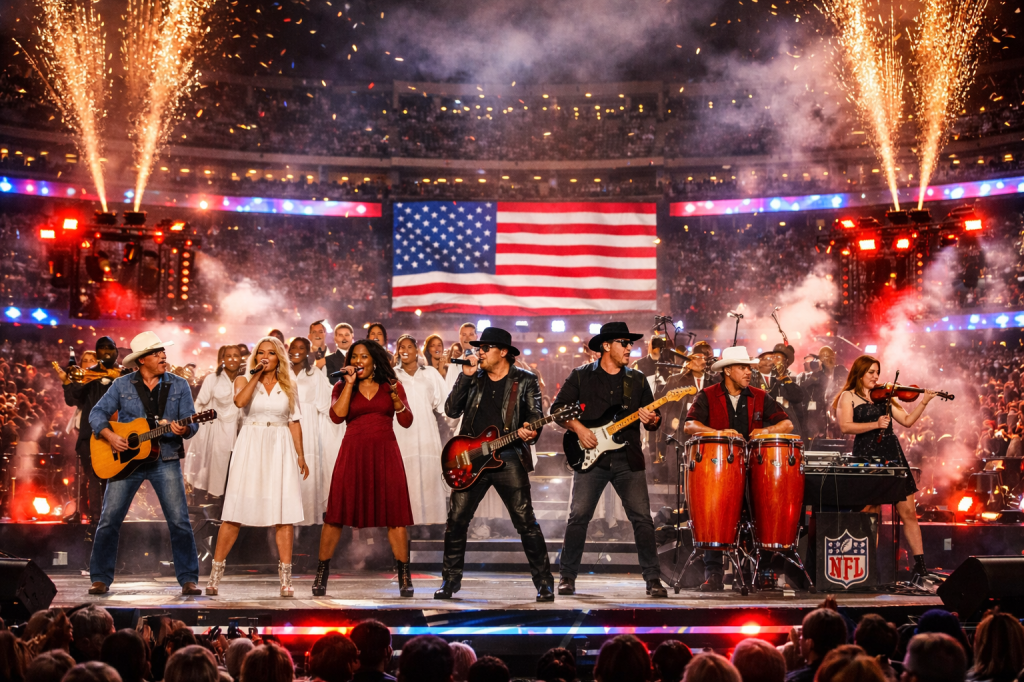
Country sharing the stage with R&B. Rock blending with Latin. Gospel bringing soul into the room. Pop tying it together. Artists having their individual spotlight, then coming together for something unified that reflects the full spectrum of this country’s sound and identity.
That’s inclusivity. Not slogans. Not hashtags. Not panel discussions. A real visual, audible collaboration on the largest stage available. Because if we’re going to talk about America representing unity in diversity, the Super Bowl is the place to demonstrate it. Not in theory. In practice.
That’s the America I believe in. Bold. Creative. Collaborative.
Confident enough to stand together instead of separated into neat little boxes.
Y’all aren’t ready for that discussion!
Anyway… y’all carry on. I’ve got snacks, peace, and zero halftime regret.
A friend made a comment that stuck with me. He said, “We need to stop giving money to any university”. I could have kept scrolling, but something in me paused. It bothered me because it made me ask a question I had never asked before. How much money is actually being poured into these institutions. And why is the federal government even involved. His comment sent me down a rabbit hole.
So I started digging.
The deeper I went, the more the picture shifted. Everything we think we know about higher education starts to fall apart once you pull the curtain back.
We assume federal dollars help students. We assume federal dollars support education. We assume federal dollars pay for classrooms, professors, and learning.
That is not the story.
When the federal government first started funding universities, it had nothing to do with student education. It had everything to do with what the government needed. Not what students needed.
During the early 1900s, the government wanted to strengthen agriculture and industrial development, so money went to land grant colleges. After World War Two, the government wanted to reintegrate millions of soldiers, so the GI Bill opened college doors. Then came the Cold War. Suddenly the government needed scientists, engineers, weapons experts, aerospace innovators, medical researchers, and technology creators. So the federal money exploded. Universities were not chosen because of students. Universities were chosen because they had the ability to build what the government wanted.
And just like that, colleges became research partners, government contractors, and innovation hubs. Federal dollars did not go to lower tuition. They did not go to reduce debt. They did not go to help families. They went into research labs, medical centers, engineering buildings, and private industry partnerships.
The entire structure of federal funding was built for national needs, not student needs.
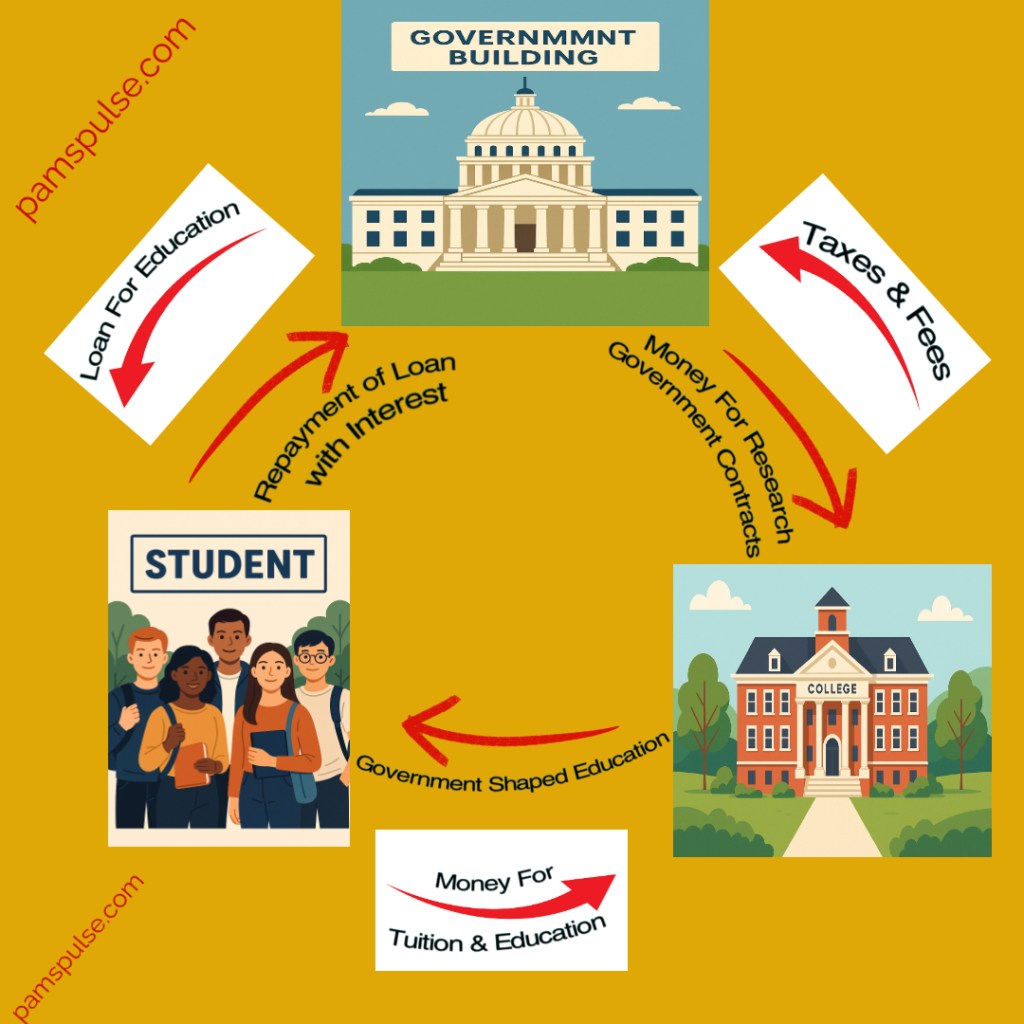
And here is where my perspective shifted. Based on my research and everything I am learning, I now see exactly what my friend meant. No federal dollars should be going to colleges and universities. Pell Grants made sense because tuition was already so high that students needed help. But the moment the federal government started loaning the money directly to students, everything changed. Colleges raised their prices because they knew the government would cover it. Students signed loans they could not escape. And the federal government created a cycle where students spend years paying back money that should never have been borrowed in the first place. This was not a gift. This was a financial trap. A revolving door of money flowing from the government to the universities and from the students back to the government with interest. But I digress. Let’s get back to education.
Once you understand the true purpose of federal funding, the next question is impossible to ignore. If the federal dollars were never meant for students, then what does that say about how this system truly operates. Because while universities were being built into national research engines, Black people were not even allowed into most Predominantly White Institutions. Our ancestors created Historically Black Colleges and Universities because they had no other choice. The doors were closed everywhere else.
And here is the truth that cannot be softened. The government built this divide. The government funded this divide. And the government still protects this divide.
This is why the comment from my friend was so important. When he said that no federal dollars should be funding education, he was one hundred percent correct. If the federal government had never taken control of higher education funding, they would have never been able to create this split to begin with. The opposition, which is the federal government, would never have been able to pit HBCUs against Predominantly White Institutions. This is part of a much larger pattern. Divide people by ethnicity. Divide them by pigmentation. Divide them by who receives access and who receives leftovers.
And look at how they did it. They shut Black people out of the well funded universities, then told us to go build our own. But even when we built HBCUs with brilliance and grit, the federal government refused to level the playing field. They fed money into the institutions we were excluded from and delivered only a fraction to the schools we created. They undereducated our children in elementary, middle, and high school. They withheld equal classroom resources. They controlled which history was taught and which history was erased. And then people wonder why more students from predominantly Black communities don’t attend these heavily funded white institutions even though the doors are now legally open.
Because the divide was never just financial. It was cultural. It was educational. And it was intentional.
So when I look at the money, the access, the curriculum, and the outcomes, the truth becomes impossible to ignore. The system was not built to be fair. It was built to maintain advantage. And it did exactly that.