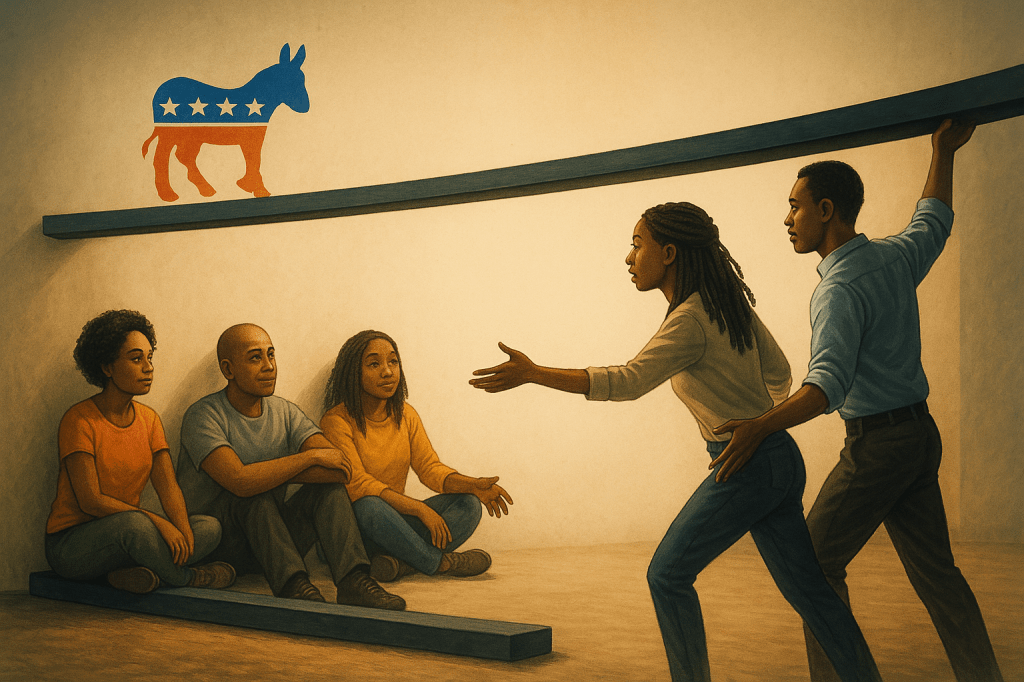
Let me tell you what set this whole thing off.
I was scrolling through one of those so called Black Excellence or Black First pages I troll every now and then, and somebody tried to clap back at a post about food stamp statistics by saying something that made me stop mid scroll.
“Well more white people get food stamps than blacks.”
And the person said it like they just dropped a mic. Like that was the moment I was supposed to sit back and say, “You know what, you are right. Let me hush.”
No ma’am. No sir.
That is not the victory some people think it is.
I do not know when surviving became something to defend. I do not know when being trapped in a cycle became something to brag about. I do not know when we started matching our struggle to someone else’s struggle so we do not have to face what is keeping us stuck.
I am not fighting for us to be equal at the bottom.
I want us to rise from the bottom entirely.
Let us talk about the real numbers
Here are the current Supplemental Nutrition Assistance Program (SNAP) participation numbers based on the latest reports:
• Around 35 to 37 percent of SNAP participants are white
• Around 25 to 27 percent are Black
• Around 15 to 16 percent are Hispanic
• Around 3 to 4 percent are Asian
• Around 1 to 2 percent are Native American
• The remainder falls into the unreported or unknown category
Yes white people make up the largest group on food stamps. They should. They are the largest share of the population.
But here is the part people love skipping.
Black households are nearly twice as likely to need assistance.
That is not a bragging point. That is a warning sign.
It is like saying, “Well other folks are drowning too.”
Okay. But why are we still in the water when we should be building boats.
What frustrates me is not the struggle. Everybody goes through struggle. What frustrates me is when we protect the struggle and defend the struggle and call it normal because we are used to it.
Some of us want to lower the bar so far that anything counts as winning.
I want the bar raised so high we have to stretch to reach it.
And here is the truth.
If you know deep down that something is not good for your community, the answer is not to justify it by pointing fingers at who else is suffering. The answer is to break the cycle.
The answer is to climb.
Do not tell me “white people do it too.” That is not the point.
It never was.
The deeper issue: Why do we defend the basement
What is happening is simple.
When people are tired of fighting, they start settling.
And when they start settling, they start defending what hurts them.
“White people are on it too” is not empowerment.
It is a coping mechanism.
It is a way to avoid asking the hard question.
Why have we accepted being under the bar for so long that we now measure progress by who else is struggling with us.
That is not liberation.
That is bondage dressed up as equality.
Western Scripture: Hosea 4:6
“My people are destroyed for lack of knowledge.”
You cannot heal what you refuse to see.
You cannot rise from what you refuse to confront.
You cannot break a cycle that you are busy defending.
Knowledge breaks chains.
Truth breaks cycles.
Accountability opens doors.
Ethiopian Scripture: Jubilees 1:25
“And I will send my angels before you, and they shall keep you in all my ways, and bring you into the land of truth and righteousness.”
Truth and righteousness.
Not excuses.
Not cycles.
Not generational patterns we have decided to normalize.
God brings us into truth. The question is whether we will live in it or run from it.
A reflection for 2025
We are at a moment where some Black folks are choosing comfort over clarity.
Memes over math.
Feelings over facts.
I am not interested in defending the basement.
I am interested in building the exit.
And I will keep saying it loud.
Poverty is not our culture.
Struggle is not our identity.
Government dependency is not our destiny.
We are not meant to survive forever.
We are meant to rise.
If you are tired of living under the bar, stop lowering it and start climbing over it.
I said what I said.
And I will keep saying it until we stop normalizing what we are meant to overcome.
 Pam's Pulse